Thank you for Visiting
Pharma Grade Peptides
High-Quality USA Research Peptides

Reset your password
Enter your email or username and we will send a secure reset link.
Continue with Microsoft
By continuing with Microsoft, you confirm you are 21 or older and accept the Pharma Grade Peptides terms.

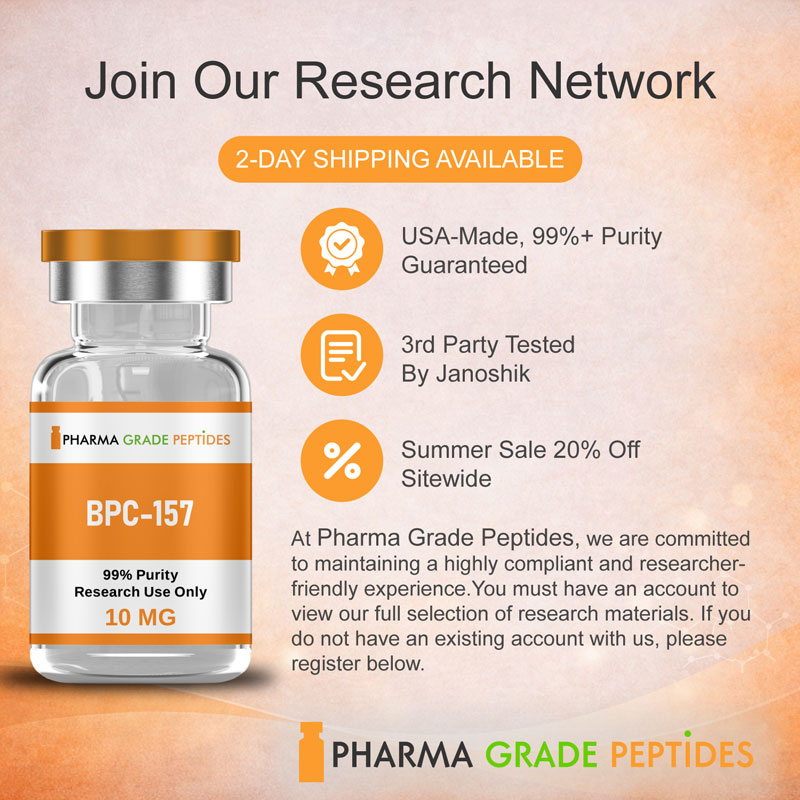
The Pharma Grade Peptides Guarantee
3rd Party Multi-Vial Batch Tested
Login for the full experience.
Customer Service and Experience Always Come First
Login for the full experience.
Third party tested
Fast Shipping
Same-Day Shipping Monday through Friday when you order before 4 PM CT! At Pharma Grade Peptides, we take pride in our fast, reliable shipping, free shipping on orders over $175 and free 2-day air on orders over $300 to ensure your order arrives without delay.
24/7 Customer Support (Monday–Friday with partial weekend coverage)
Frequently Asked Questions
Need Help?
To support our compliance commitment and ensure our research materials are only made available to qualified researchers, we require all visitors to log in or register before viewing our full catalog.
Orders typically ship within 1-2 business days. Same-day shipping is available for orders placed before 4 PM CT. Delivery within the United States generally takes 2 business days, but on rare occasions, it can take up to 5 days.
Please reach out to our customer support team via the Contact Us page with your order number. We will investigate the shipment immediately and work with the carrier to resolve any issue.
A Certificate of Analysis (COA) is an official analytical document issued by an independent, third-party laboratory. It details the precise identity, purity percentage, mass confirmation of a specific production batch based on analytical testing protocols.
All research compounds and materials supplied by Pharma Grade Peptides are classified strictly as Research Chemical Materials solely for use in laboratory, in vitro, and analytical evaluations. They are explicitly not approved by the FDA for human consumption, veterinary use, or therapeutic applications, and any indications outside of their intended use is strictly prohibited.
Peptides are short chains of amino acids studied in laboratory settings for their signaling and structural properties, alongside related research compounds.
Every product vial and compound container features a unique batch identification number. Additionally, Pharma Grade Peptides includes a QR Code on each vial and package for easy, direct access to all corresponding third-party COA laboratory reports.
High-purity reference peptides are typically synthesized to meet or exceed 98% purity, as measured by High-Performance Liquid Chromatography (HPLC). Mass Spectrometry (MS) is simultaneously utilized to verify that the molecular weight exactly matches the target chemical sequence.
Compound identity and purity are verified using a combination of High-Performance Liquid Chromatography (HPLC) to measure chemical purity, Mass Spectrometry (LC-MS) to verify exact molecular mass to ensure material integrity for laboratory applications.
High-Performance Liquid Chromatography (HPLC) is an analytical chemistry technique used to separate, identify, and quantify each component in a chemical mixture. It works by pumping a liquid solvent containing the compound through a column filled with a solid absorbent material; each component interacts differently with the material, allowing precise measurement of purity and composition.
In-vitro (meaning "in glass") refers to laboratory procedures and experimental studies conducted in controlled, isolated environments outside of a living organism, such as inside test tubes, petri dishes, or cell culture plates.
Peptide synthesis is the chemical process of assembling specific amino acid chains in a defined sequence. Solid-Phase Peptide Synthesis (SPPS) is the standard method used to construct precise peptide chains for experimental research applications.
Lyophilization, or freeze-drying, removes water content from a compound solution under vacuum at low temperatures. This process preserves the molecular structure, prevents premature degradation, and stabilizes the compound for long-term solid-state storage.
Lyophilized research solids should be stored sealed in a cool, dry environment (typically 15°C to 25°C for short-term shelf life, or -20°C for extended storage) away from direct light and moisture to maintain chemical stability. Aqueous solutions should be stored between 2°C and 6°C.